Anna Coleman Watts Ladd (July 15, 1878 – June 3, 1939)
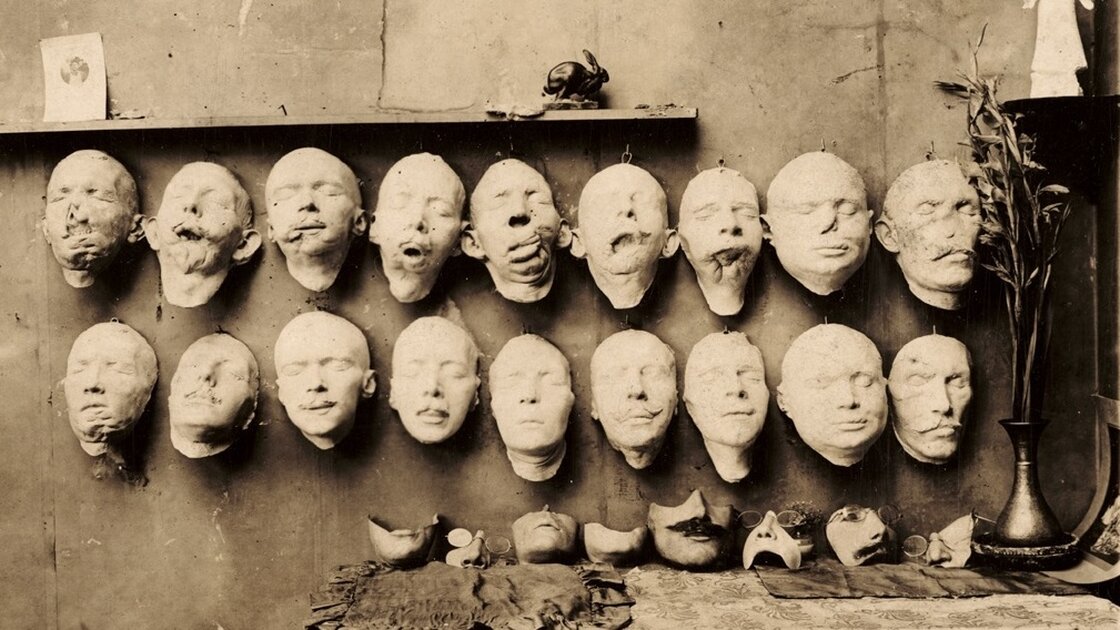 |
| Top Row shows casts of patients injuries. Bottom Row, work in progress and On the Table finished masks. Smithsonian.com |
Art is thought to change the way we perceive the world, but Anna Coleman Ladd made something that changed how we saw people.
World War One changed Europe forever, claiming the lives of 8 million people and wounding at least 20 million more. Soldiers were often horrifically maimed during the fierce trench fighting, whether by the heavy use of artillary shell or the machine gun.
"The part of the soldier's body that was most vulnerable was his face,
because if he looked up over a trench, that was the part that was going
to be hit," says David Lubin, professor of art at Wake Forest University.
These men felt that they could not return home to their wives, fiancees, friends and lives they left behind due to their disfigurements. A huge number of these soldiers were depressed or ostracised from society and this quickly became something that needed to change.
"These men couldn't be seen on the street," says Lubin. "They'd gone
through multiple operations, and they were seen as so hideous people
would sometimes pass out from seeing them."
 |
| Patients with facial injuries or masks gather for a Christmas party 1917. Smithsonian.com |
Francis Derwent Wood was working as a wartime orderly in 1917 and saw an opportunity to use his artistic abilities to help these men. He opened the first "Tin Noses Shop" although that could be the subject of a whole other blog post. Anna Coleman Ladd was a sculptor who between 1905 and 1917 was only known for her statues of children, nymphs
and historical figures, but due to her husbands involvement with the Red Cross Anna became exposed to Wood's work and knew she could help.
Wanting to improve upon his methods and work she scoured the front line hospitals for patients, opening her own studio in Paris. Using photographs (the camera being widely available from 1901) of the soldier taken before his injuries, or working from the patients descriptions, she sculpted a close facsimile of the man’s original features. Producing first a plaster cast then a mask of natural latex collected from evergreen trees. She would then galvanize this mask in a copper bath infused with electric current, resulting in the creation of a thin, light, mask that she could paint to match the soldier’s skin tone.
“If the wounded man was blind, the mask would be equipped with artificial eyes,” “Eyelashes, eyebrows, and even mustaches were affixed in the masks. They were light and durable. The masks will last a lifetime.”
Anna Coleman Ladd


These two images show the before and after of a soldier with a newly fitted mask. Smithsonian.com
It is beleived that between 1917 and 1919 Ladd and her colleagues created nearly 200 labour intensive hand crafted masks.
Eventually in 1932 the French government honoured Anna's work by awarding her the Legion d'Honneur Crois de Chevalier. Few if any of her masks seem to exist today and it is quite possible that some may have been buried with their owners (it is reported that Ladd apparently destroyed some herself). Sadly her accomplishments were largerly forgotten and by the time of her death in 1939 she was considered a minor sculptor, if she was remembered at all.
Although i'm sure that the soldiers and families she crafted back together, never forgot her name or the difference she made with thin copper, paint and string.

No comments:
Post a Comment